Tuesday, July 19, 2011

Fritillary Fun

Brad and I are now on our own, Ty left camp yesterday and won't be back until the 3rd when I fly back to Michigan. We now have the pleasure of holding down the camp, doing data entry and chillin' until I leave.

Today was sunny, warm (~60 degrees!) and calm. Obviously I was excited for the butterflies, but not so much about the mosquitoes. I had no idea that a huuuuuuge herd of Caribou would be coming through today, at least 1500 strong spanning the horizon. Quite a sight to see!

We had quite a walk to our sites to collect vegetation, and with the amount of Caribou, there are bound to be bears around, so we were packing heat in the form of a shotgun. Luckily, it didn't need to be used. On the walk I used my pathetic excuse for a butterfly net to trap butterflies. About 50% of them escaped the contraption, but the other 50% were harassed with my camera. Quite a few Booth's, Hecla and Labrador Sulphurs were around, but I didn't bother with them. I caught quite a few Fritillaries, and was surprised to find one that I have yet to see this season... I think.

First I'll start with the Arctic Fritillary, one I have seen this field season.
Pretty typical Arctic Fritillary (Boloria chariclea) underside.
Arctic Fritillary (Boloria chariclea) upperside.
Now here is one I am having difficulty with. I identified it in the field as a Freija Fritillary, but it doesn't match perfectly in my guide, and for a few minutes I was going between Freija and a really fresh Arctic. It does look pretty good for Freija compared to other pictures online, though. They are "supposed" to be early season flyers... I guess this one didn't get the memo.
Freija Fritillary, I think, underside. It isn't just a really fresh Arctic, is it? Opinions welcome.
Obviously more dark above than the Arctic Fritillary earlier in the post, with bigger/darker spots.
The birds... are pretty much gone. A lot of juvenile Semipalmated Sandpipers raging around the tundra and getting into trouble. We have only 2 active shorebird nests left, and one active Pacific Loon nest.

With this job wrapping up, you may be wondering what I'm doing after. I will be attending a friends wedding right as I get back to Michigan, then it looks like I'm coming back to Alaska. I will either be observing seabirds on a 3 week cruise through the Beaufort Sea on a converted crabbing vessel, or I will be "volunteering" as an observer on a ~9 day cruise starting in Adak and hitting the eastern Aleutians to pick up seabird crews that are finishing their field season. If I can get a "cold water immersion" class before the Beaufort trip, I will be observing on that. If I can't, I'm heading for Adak. Either way, its certain not to disappoint!

Saturday, July 16, 2011

Dingy Fritillary

Yesterday afternoon the sun came out for a couple hours, and although it was really windy, a few butterflies were flying around. I ended with 6 species, and was able to confirm that Hecla and Labrador Sulphur have both been flying with Booth's. I also snagged a new species for me, a Dingy Fritillary. The list below.

Booth's Sulphur
Labrador Sulphur
Hecla Sulphur
Frigga Fritillary
Polaris Fritillary
Dingy Fritillary
Dingy Fritillary Boloria improba - The Alaska subspecies resembles Frigga Fritillary below, but is about half the size and isn't as contrasty. Also, the top side is very dark compared to the other Fritillarys flying on the slope.
Very dark upperside.
Here is to hoping for more sunny days. I will be going to some different habitat on the next sunny day. It sure would be nice to find Banded Alpine or Disa Alpine...

Friday, July 15, 2011

Babies

The first Red-throated Loon nest hatched either today or yesterday. They are nothing more than a bunch of fuzz.
Red-throated Loon just a day or two out of the egg.
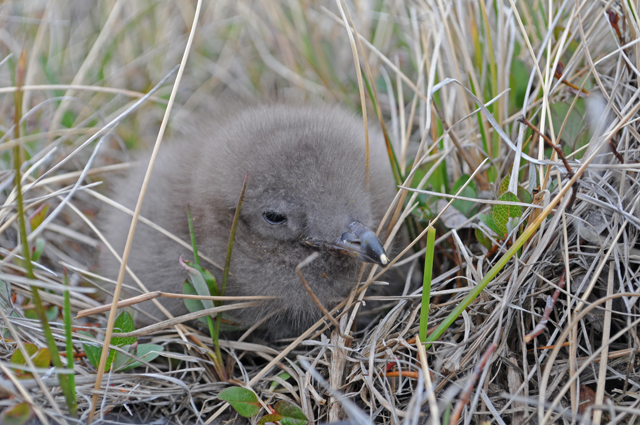
The Long-tailed Jaeger that hatched two weeks ago is getting quite large, and quite ugly compared to the loons.
Careful, they bite!
Flight feathers growing in. In another couple weeks we may see him flying around!
Tomorrow and the next couple weeks involve data entry sprinkled with a bit of vegetation sorting. It is mindless work, but important. Weather has been cloudy and windy for what seems like forever (probably a week). I'm praying for a sunny, warm day so I can go see what is flying.

Wednesday, July 13, 2011

Nearing the End

Due to the lack of posts lately, you probably have figured out that the shorebird breeding season is nearing its end. Truth is, nothing too exciting has happened lately. Yesterday we banded our last bird of the season, a Red Phalarope.
Red Phalarope Wing
Funny Phalarope Feet. Check out the lobes and webbing on these guys.
Today we finished the last predator surveys, sampled and closed down the invertebrate traps and conducted our final "snow" survey of the year. Our south plot has only one shorebird nest left, a Red-necked Phalarope. Our north plot has a few more nests, but should be done in the next few days.

Ty, one of the full time USGS people, leaves on Sunday, so it will just be Brad and I left to fend for ourselves for a couple weeks. We can keep busy with sorting grass (about as exciting as it sounds) and entering data. It will be a long couple weeks, but I can't wait to be back in Michigan!

I'm not sure what I'll be doing next, but have a few options and big things could happen. A few things are still up in the air, so we will see how they pan out over the next week or so.

Till next time, David out.

Friday, July 8, 2011

Alaska Butterflies

Now that it is early/mid July and the weather has warmed up, butterflies diversity has increased greatly. I built something resembling a butterfly net, but it is quite rough. However, it did allow me to catch a few Fritillaries today, both Arctic and Frigga. This makes 3 species of Fritillary for the camp area including Polaris. Also, there are some deep orange Sulphurs flying around, but I've yet to catch one. They have got to be Hecla Sulphur, but I'd like to catch one first before calling it. There was also a small blue butterfly, which I thought had tails and thought was a Western Tailed-blue, but they aren't "supposed" to be around here. I'll probably never see it again. Here is a recap of some of the butterflies from this season.
Polaris Fritillary- on my hand.
Arctic Fritillary
Frigga Fritillary
Booth's Sulphur
On a work related note, we finished banding Ruddy Turnstones and Dunlin, and will probably only band a couple Red and Red-necked Phalaropes. The plots are pretty boring now, most of the birds have hatched or been eaten and only a handful remain. This leaves us with sorting vegetation, collecting insects, and entering data. Luckily, I have enough movies, music and internet to keep us motivated... for now.

Monday, July 4, 2011

Red-throated Loon

We have been monitoring 2 Red-throated Loon nests, and one has a pretty cooperative bird. I was able to sneak up on one of the birds and managed a series of 150+ pictures of this gorgeous bird. Here is a quick edit of one of them.
Breeding Red-throated Loon in evening light. I'm quite happy with this one.

Still lots of shorebird chicks hatching and running around, trying to avoid Jaegers (I saw 20+ Long-tailed Jaegers on South Plot today). I also got attacked by a female Rock Ptarmigan that I almost stepped on whilst she was incubating her 10 eggs. She made a flight for my face, luckily I dodged the attempt.

Happy 4th of July! Drink a beer for me if you are celebrating today. I know I would be.

Friday, July 1, 2011

With every day flying by here on the Colville River Delta, every day feels more and more like fall. Apparently, seasons go straight from spring to fall, and forgo summer. Today started with a cool NW wind and high puffy gray overhead clouds, and I couldn't help but think I should be lakewatching on Superior. It felt even more like fall with the weather coupled with the big flocks of obviously-ready-to-migrate shorebirds. Pectoral Sandpipers, Red and Red-necked Phalaropes and Semipalmated Sandpipers are all grouping up in large flocks, feeding like crazy, and looking a little antsy. A few failed-nesting Dunlin are thrown in the mix as well.

The Long-tailed Jaegers seemed a bit more hostile than usual today. They were due for a nest check, and the eggs were replaced by Jaeger chicks.
Our ever present, and loud and obnoxious Bar-tailed Godwit pair had their first egg hatch today. The other 3 were quite close to hatching as well, and are probably out as I write this.
I also had the chance to get some male Godwit pictures last night when the sun came out for about a half hour. I haven't edited most of them yet, but here is one of my favorites!
Lots of other nests hatching like Brant, White-fronted and Snow Geese, Semipalmated Sandpipers and Dunlin, and Lapland Longspurs, among the others. I even saw Semipalmated Sandpiper chicks running around the tundra today. Things are happening fast, soon there will be little work to do. Then it is on to data entry!