Monday, August 15, 2011

Weekend in Homer, Alaska

Due to delayed planes, I was able to accompany a friend to Homer this weekend to do some birding. The target was the Long-billed Murrelets that have been present in Kachemak Bay for a couple months. On Saturday, we birded our way down do Homer, with stops at Whiskey Gulch and wherever we thought there might be birds. We found quite a few groups of passerines which included many Orange-crowned, Townsend's, Blackpoll, Yellow-rumped, Wilson's Warblers and Northern Waterthrush. Fox, Lincoln and Savannah Sparrows were abundant, and this Fox Sparrow proved somewhat cooperative in the dull, overcast light.
At Whiskey Gulch, we had a ton of birds moving over the water. Hoards of Shearwaters (most too far to discern details, but presumaby/almost certainly Sooty Shearwaters), Horned Puffins, Common Murres and hybrid gulls provided much amusement.

Homer was great as always. We passerine-birded this morning at various locations along the spit. More of the same were had, lots of Orange-crowned, Townsend's and Wilson's Warblers, Fox Sparrows, Song Sparrows, ect, ect.

The boat into Kachemak Bay was great. We left at 8:30am and had a few hours before the wind picked up to sort through a plethora of Murrelets. The bay is loaded with Murrelets and it is impossible to even sort through the majority. Most were Marbled, with a smattering of Kittlitz's Murrelets thrown in, a dandy lifer. Some even provided a photo opportunity.
Try as we might, we were unable to locate a Long-billed Murrelet, but it wasn't for a lack of trying. With all the Murrelets present in the bay, it is quite possible they are still around. We also didn't turn up a Fork-tailed Storm-petrel, which would have also been a lifer. But, I'll take the Kittlitz's!

On the drive home, we saw a Black Bear drag a fish across the road.

Tomorrow my plane leaves out of Anchorage for Prudhoe Bay at 2pm. Let's hope it works out this time, I'm anxious to get on the boat and start these seabird surveys!

Saturday, August 13, 2011

On Fire!

My plane ride to Deadhorse got cancelled today, and is rescheduled for Monday, August 15th due to high E winds making for a dangerous boat-to-boat transfer. Therefore, I hiked Glen Alps again in the Chugach State Park where we saw the Wolverine. This time I was after Northern Wheatear.

Upon pulling into the parking lot, I saw a car on fire.
Obviously this was a good start. I hiked in alone without bear spray and played around on Wheatear habitat until I got bored of the lack of Wheatears. I then hiked back, picking luscious Blueberries and scarfing them down on the way. I also took time to photograph a curious Golden-crowned Sparrow.
A sparrow with a golden crown.
I also finally saw some butterflies. A few Milberts Tortoiseshells and what appears to be a Green Comma.
I also saw a very large moose who took the time to examine my every move as I walked by.

So, now that I have the weekend to do whatever I want, Luke DeCicco and I are going to spend the day birding our way down to Homer tomorrow, and on Sunday we are joining a few others who wish to look for the Long-billed Murrelets that have been around for multiple months. Even if we don't get the target, Kittlitz's Murrelet is pretty much a guarantee as long as I keep my eyes open, and other sweet birds will be around too. 

Here is to hoping some of my good luck lasts for the LBMU!

Friday, August 12, 2011

WOLVERINE!!!

This couldn't have made for a better last post before I head into the chilly Arctic waters that lie ahead.

My friend Luke DeCicco and I ventured into Chugach State Park hoping to find my life Northern Wheatear. While we were almost to the turn-off, a guy noticed our cameras and binoculars but walked on by. Thankfully, he decided to turn back around and brag that he just saw a Wolverine. Luke and I didn't believe him until he grabbed his camera and showed us pictures of the beast. We had a choice, go left for the Wheatear, a life bird, or right for a very slim chance at re-finding a Wolverine. Luke mentioned that even if you have a 1/1000 chance of seeing a Wolverine, you go for the Wolverine. So we did.

After a while of not seeing anything except a few Golden-crowned Sparrows and Yellow-rumped Warblers, we were joking around and had given up hope on the creature that is a Wolverine. Just then, the beast in all of it's glory trotted onto the path not even 30 meters ahead of us and we nearly lost bowel control. It gave us the best looks we could ever ask for and then some. My camera acted up, and it was on the shadow-side of the mountain, so I didn't get great pictures, but Luke got amazing ones. I can't post his pictures since I don't have permission, but I'll post my terribly blurry ones.
After the Wolverine paused in the path, stopped and looked at us for ~40 seconds, I finally managed to peel my eyes off my binoculars and got my camera working. By that time, the Wolverine was headed up the mountain.
This is possibly the coolest thing I have ever seen in my life, right next to Polar Bear. Because Wolverines are so nomadic and densities are so low, and habitat is everywhere, it makes ever finding one of these creatures nearly impossible. They are also extremely vicious, known to fight Wolf and Bear off of their kill. Honestly, this is one animal I figured I would never see in my life. This once-in-a-lifetime experience will never be forgotten.

Tomorrow morning I head off to get on the Norseman II and depart into the Beaufort Sea for 3 weeks of seabird surveys. I'll update you when I'm back!

Life is good!

Monday, August 8, 2011

Zen-Ray ED3 Binoculars

After 6 years of hard abuse to my binoculars, it was time for an upgrade. I had the Swift Audubon HHS 8.5x44, and loved them until the end when they got too scratched up/foggy to give me a clear image. If you are like me and simply cannot afford a pair of Swarovski binoculars, but still want top performance, keep reading.

After reading many reviews about the Nikon Monarch series, Bushnell Legend Ultra HD's, Swift binoculars, ect., I came across a brand unfamiliar to me... Zen-Ray. Obviously I was skeptical, but after reading a bunch of personal reviews on "BirdForum" and elsewhere, I quickly became interested. Plus, they were coming out with a new model, the Zen-Ray ED3 released on August 1, 2011. After much deliberation and hesitation, I ordered the 8x43 ED3's with a 20% discount that Zen-Ray offered at the time.

I've been using the binoculars for a few days now, and I'm 100% sure I made the right choice. These binoculars blow my Swift Audubon HHS out of the water. To get the ball rolling, here are the specs:

ED Glass
Dielectic Prism Coating
Speedy Focus
Multi-coated Optics for 99.7% light transmission
Water/Fog Proof
ect, ect.

After reading all the hype, I was actually nervous to put them to my eyes for the first time. When I mustered up the courage to look through them, it was magical.

These have to be one of the brightest optics I've seen, performing very well in low light and high contrast situations. They are almost too bright... almost. The contrast produces a pleasing, clean, neutral image that will leave you drooling. I never wanted to take them away from my face.

The binoculars are further complimented by a crisp, sharp image that comes into focus quite quickly. Because my old binoculars focused really slow, it has taken me some time to get used to a fast-focus binocular. I often pass the "sweet-spot", but I'm sure that I will get used to them in due time. The sharpness does drop off somewhat at the edges, as it does with most/all binoculars, but it is not bothersome to me. I have to look for it to notice it.

The look and feel work well for me. They are cleaned-up from the ED2 model and seem well built. The tripod mount cover gets loose once in a while, but is a quick screw back into place. The optic covers that come with them do not feel like they will come off by themselves. Overall, they have a good feel to them, for me at least.

I'm not a pro-binocular tester, and haven't used the alpha-glass (Zeiss, Swarovski, Leica) much, but others are already placing these binoculars in the "alpha" category. They certainly produce a better image than my Swifts and my fathers' Nikon Monarchs. And at 1/4 or 1/5 the price of the alphas, you can't go wrong. The warehouse is in the United States, and customer service is very good. I ordered them directly from Zen-Ray and after they shipped, it was only 2 days before they were in my hands.

I have no affiliation with Zen-Ray, and did not get paid to write this review, but it would be nice if I had. I'm only writing this to help binocular-seekers who desire a high quality image on a budget. I'm also kind of bored waiting for my plane to take me back to Alaska...

Wednesday, July 27, 2011

More Bird Pics

Well I was pretty bored today, so I went and birded the lake north of our camp which seems to be a staging area for shorebirds. It is the only place I constantly see large flocks of shorebirds. The numbers of Stilt Sandpipers have increased with 6 juvenile and 1 adult present today. Long-billed Dowitchers continue as well, in lesser numbers than previous days. Only juvenile Semipalmated Sandpipers remain, adults have been gone for qutie a while. Still a lot of Red-necked Phalaropes and a few Black-bellied Plovers, and very few Pectoral Sandpipers.

The Jaegers are doing well. I finally shot a decent picture of one of the full grown juveniles.
The 2 juvenile birds were flying around today, practicing aerial agility. They are getting pretty good!

I also spent some time playing with Arctic Terns. I can not seem to get a good shot of these guys. I'm guessing it the contrast between them and their environment. Whatever it is, I still can not get that "great" shot.
I splurged a little last night and ordered a new pair of binocular. My current bins (Swift Audubon HHS 8.5x44) are getting really trashed, with scratches so extensive on the lenses that it is affecting sharpness, brightness, contrast and overall image quality. There are even some "cloudy" areas that won't focus, and this just won't do. After EXTENSIVE deliberation between Nikon Monarch, Leupold Mojave, Bushnell Legened Ultra HD and a few others, I decided on a brand I had never heard of before... Zen-Ray. I have done extensive research into this company, and read as many possible user reports as I possibly could, and it seems they are legit. They are coming out with a new Zen-Ray Zen ED3, and with a ship date of August 1st, and my return home a few days after that, it was like a sign. Many user reviews of people who obviously know way more about binoculars than I claim they rival the alpha (Swarovski, Zeiss, ect) binocular lineup. They say the alphas are slightly better, but not to warrant an extra $1500. Anyway, time will tell, and I'll fill you in when I get them. Obviously, I'm both excited and nervous. With specs such as ED glass, field of view 426/1000, dielectic prisim coating, phase correction, water and fog proof, it has me drooling.
http://www.zen-ray.com/shop/binoculars/zened3/zened3-8x43.html


Tuesday, July 26, 2011

Learning to Fly

I took a walk around the tundra briefly today and was surprised at how fast these birds grow up. I ran into quite a few juvenile birds that can now run, fly, feed themselves and call to their parents. The first was the Long-tailed Jaeger juveniles that I've posted pics of in the past. They now fly and call, and don't let us approach nearly as close as we used to. I hope we get another nicer day (45 degrees, cloudy and windy today!), I'd like to get some better pictures of them.
Can't pick this guy up anymore.
I then ran into a disgruntled adult Red-necked Phalarope. I quickly saw this....thing swimming and awkwardly walking away from me.
I'm not sure if this is cute or disturbing.
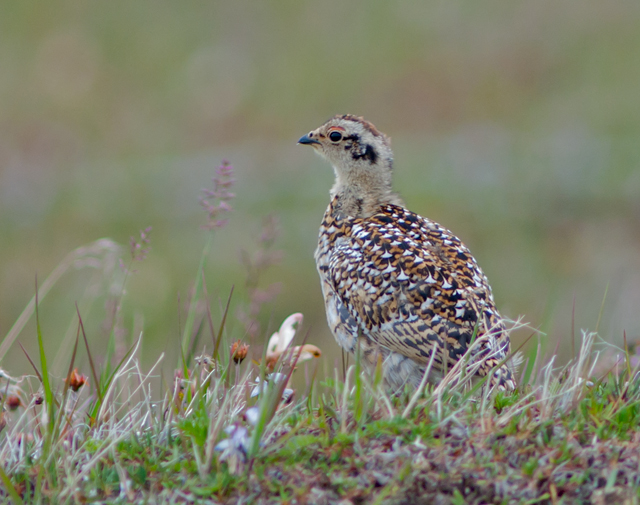
It seems Ptarmigan all group together after the breeding season and during brood rearing. I saw an abundance of Rock Ptarmigan, and only a couple Willow. There were also hoards of young running around, now probably too big for the Jaegers to eat. These Ptarmigan have an average clutch size of 10-11 eggs, quite a handful to keep track of!
Young Ptarmigan of some kind.
I also happened across a very bright shorebird that had me excited for a moment. I had yet to see a full juvenile Pectoral Sandpiper, and this one was exceptionally red overall. However, it is way too early to be claiming a Sharp-tailed Sandpiper.
Juvenile Pectoral Sandpiper. Not enough going on with the eye ring, eye stripe or crown for a Sharp-tailed Sandpiper.
We are running out of things to do at camp. After tomorrow, we may be completely done with everything, leaving at least a week of free time. Not sure what we will do with all that time, maybe I'll put some serious effort into my new website design. I recently revisited my forgotten website (www.pavlikphotography.com). Why didn't anyone tell me it looks horrible?! Seriously, I'm appalled.

Sunday, July 24, 2011

Wrapping Up

After a serious bout of food poisoning, I'm back at it. We almost have all the data entered and proofed, and that should be wrapped up in a few days. Inventory has begun, along with all those other minor end of field season details that need to be hammered out.

A few days ago a huge herd of caribou came right through our camp. We estimated the herd at 2000, but there may have been more.
Busting a move to the other side of the lake

You can see our "bear" fence in this picture. This is literally right outside our tents and weather-port.
Later in the day, after the herd passed through, we had a bit of a scare. A loud crashing sound of something going through the bear fence (which wasn't turned on at the time) had Brad and I thinking we had a bear. Turns out a mother caribou and her young didn't see the yellow rope and went crashing right through it, breaking some of the white fence stakes as well.It was an easy fix, just glad it wasn't a bear.

I arrive back in Lansing on August 4th, and fly back to Anchorage on August 9th. On August 10th I take a Cold Water Survival class in Anchorage, then on the 14th I get on the Norseman II boat (a converted crabber) and hit the Arctic Ocean, mainly the Beaufort Sea area, for 3.5 weeks. Previous cruises saw a whole 7 species of which over 80% were Arctic Terns, Black-legged Kittiwakes and phalaropes. It could be a lonnnnng 3.5 weeks.